
VerifyVASP at Vietnam's Nationwide Crypto-Tracing Training for 27,000 Police Officers
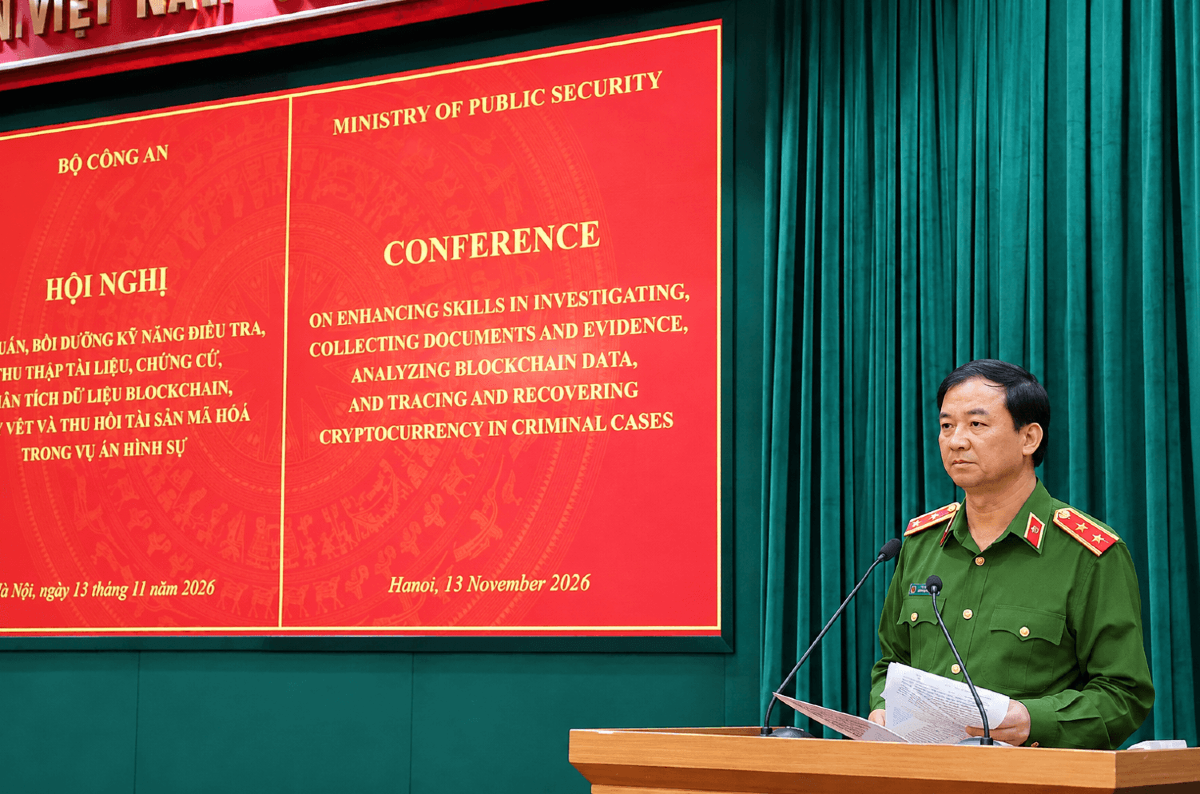
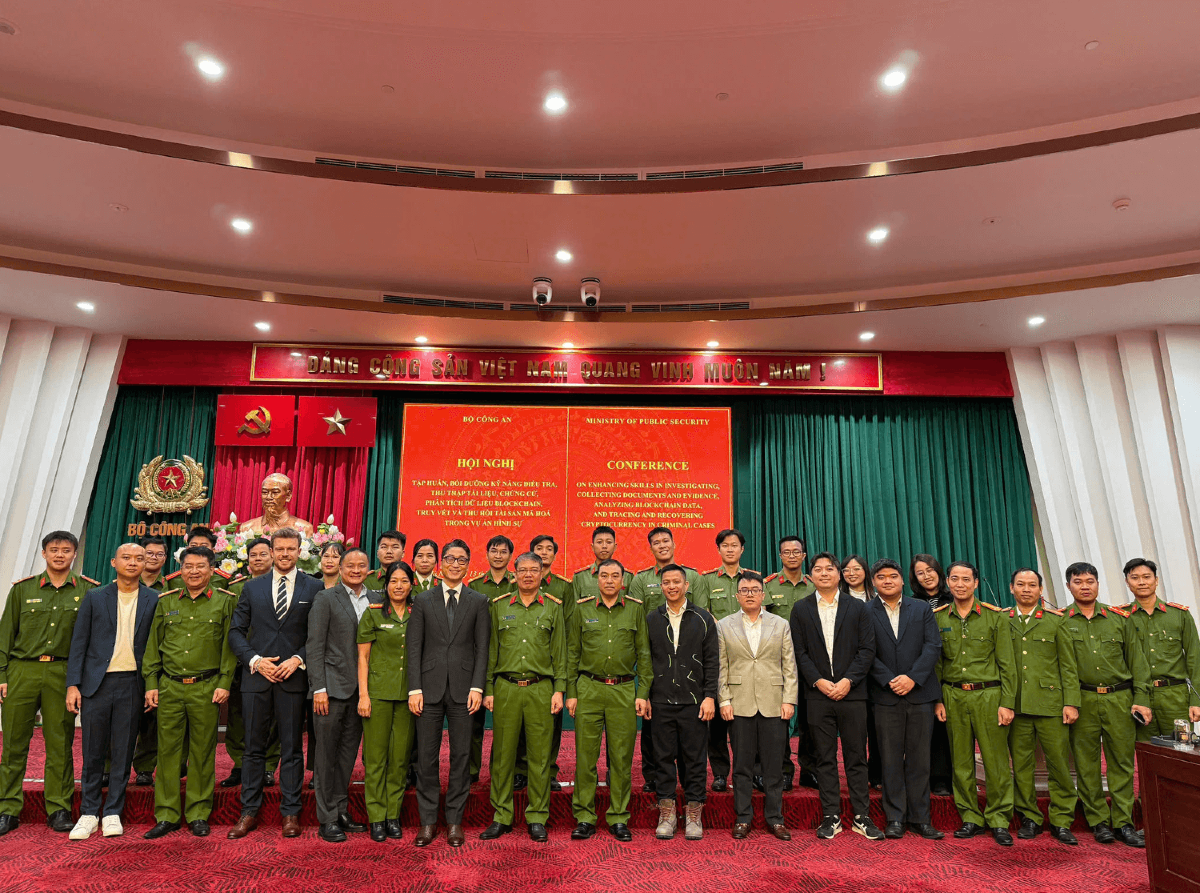
On 13 November 2026, Vietnam's Ministry of Public Security (MPS) ran one of the largest crypto-crime training programmes, with more than 27,000 leaders, commanders, investigators and officers took part, in person at the MPS Conference Hall in Hanoi and online from police units across the country, down to communal police. VerifyVASP was honoured to have been part of it.
The conference was organised by the Office of the Criminal Investigation Police Agency, under the direction of Senior Lieutenant General Nguyen Van Long, Deputy Minister of Public Security, and chaired by Lieutenant General Tran Minh Tien. VerifyVASP was proud to be invited to speak on the Travel Rule, alongside INTERPOL and Vietnam's State Securities Commission, as well as other private sector partners including Upbit, TRM Labs, zeroShadow and Recoveris.
The training came shortly after the Financial Action Task Force (FATF) published its report on illicit financial flows linked to scam compounds, which calls for the response to fraud to move at the same speed as the money. Vietnam's programme is a practical example of that agenda being put into action, and it shows why the Travel Rule is an essential element of the shared fraud-fighting infrastructure, not a compliance checkbox. Last month, the FATF called on Vietnam to make tangible improvements to rectify its strategic AML/CFT deficiencies.
What the Programme Covered
The one-day programme ran seven sessions covering six topics, from blockchain fundamentals to advanced cross-border recovery:
- Blockchain and Web3 fundamentals: how networks such as Bitcoin, Ethereum, USDT on TRC20 and BEP20 work (TRM Labs)
- The legal side: collecting evidence and recovering virtual assets under Vietnamese law (State Securities Commission)
- The crypto-exchange's view: detecting suspicious transactions, preserving evidence and working with law enforcement (Upbit)
- Cross-border evidence: obtaining electronic data from other jurisdictions (INTERPOL)
- The Travel Rule: identifying the VASPs in a transaction and supporting cross-border information sharing (VerifyVASP)
- Incident response and forensics: rapid tracing of stolen assets, and cross-border freezing, seizure and recovery (zeroShadow, Recoveris)
Officers then worked through simulated, technology-based group exercises tracing funds in a fraud case.
The Message from the MPS: Trace Early, Verify the Person
The MPS framed cyberspace as a new strategic are for crime prevention, with virtual assets increasingly misused for fraud, online gambling, transnational money laundering and hiding proceeds. The directives to investigators were practical: identify the wallets, exchanges and platforms involved; follow funds across chains, mixers and offshore venues; and start tracing, freezing and recovery during the investigation, before assets are dissipated.
One point stood out. Lt Gen Tran Minh Tien cautioned that blockchain analysis results must not automatically be treated as the sole basis for identifying a person, and must be corroborated with other evidence.
That is exactly where the Travel Rule comes in.
Six Principles in Practice: How the Training Maps to the FATF Agenda
On 5 November 2026 the FATF published a 90-page report entitled Combating End-to-End Illicit Financial Flows Linked to Scam Compounds, with nearly 120 case studies from more than 60 jurisdictions and six new FATF principles for disrupting scam compounds. It builds on the FATF's Anti-Fraud Toolkit, which maps how its 40 Recommendations already equip countries to fight fraud: risk assessment, international cooperation, public-private partnerships, virtual asset regulation, payment transparency and asset recovery. Both name virtual assets as a central laundering channel. We looked at what this means for the Travel Rule in our earlier post, Following the money, at speed: what FATF's new scam-compound principles mean for the Travel Rule.
Vietnam's training lines up closely with that agenda:
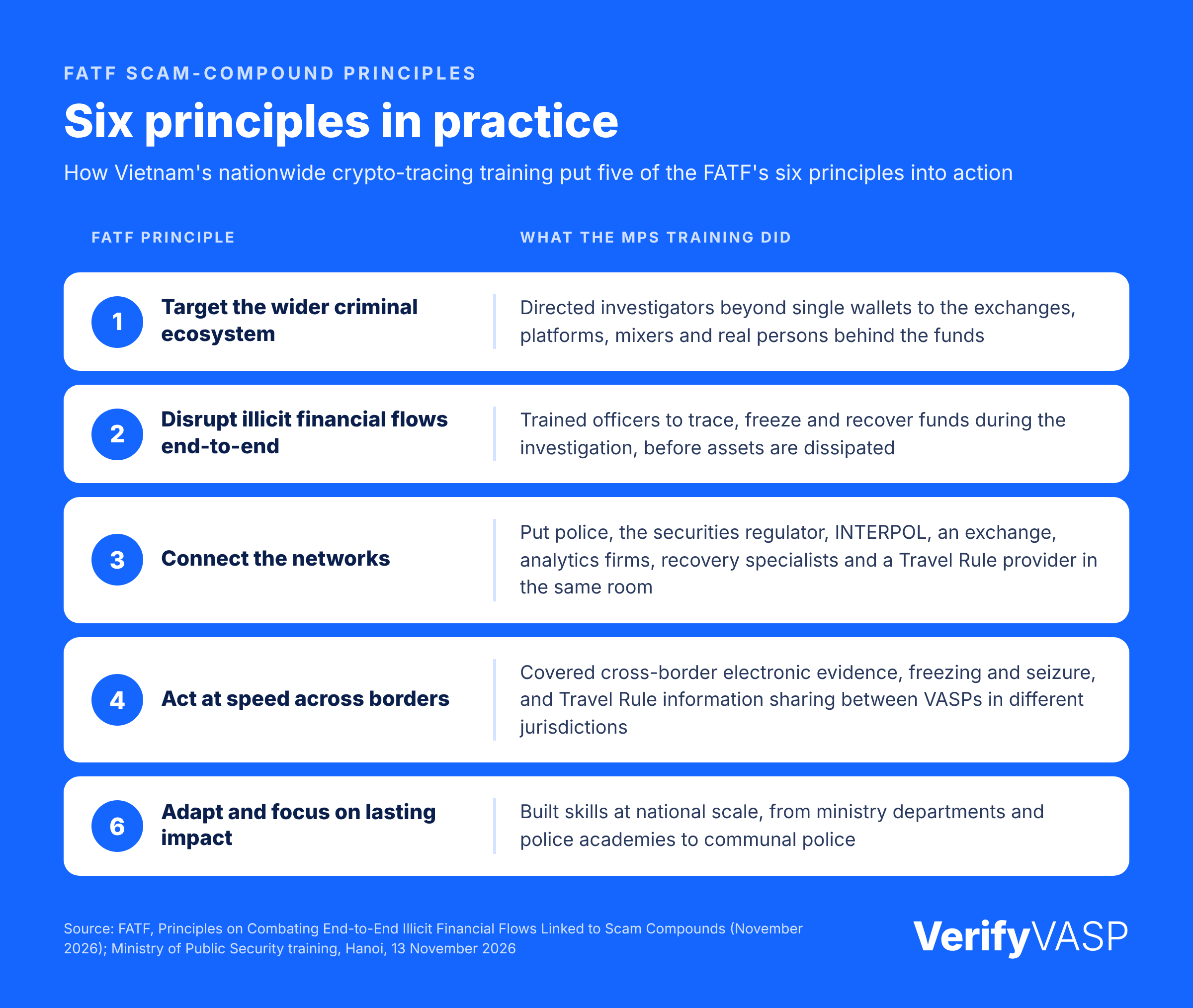
The programme also reflected three Anti-Fraud Toolkit priorities: public-private partnership, by bringing the public and private sectors together, and virtual asset regulation and asset recovery, by pairing the legal framework for crypto evidence with hands-on recovery and Travel Rule sessions.
The FATF is explicit that the first 24 to 72 hours after a scam is detected or reported decide whether funds can be frozen. Rules and tools only win that window if the officers on the ground know how to use them. Training more than 27,000 of them is a direct and remarkable capacity building effort.
Where the Travel Rule Fits: from Wallet to Person
"Tracing tells you where the money went. The Travel Rule tells you who was behind it, and which regulated firm can act." That was the key message of VerifyVASP's session, which explained how the FATF Recommendations apply to virtual assets.
Blockchain analytics tells investigators where funds went. It does not, on its own, tell them who controls a wallet. The Travel Rule (Recommendation 16) closes that gap at the points where virtual assets touch the regulated system:
- It identifies the VASP. When funds land at a licensed exchange, investigators know which institution holds the account, and where to send a request or a freeze order.
- It ties transfers to verified customers. Originator and beneficiary information must accompany qualifying VA transfers, collected by VASPs that have already performed customer due diligence. That is the corroborating evidence the MPS is asking for.
- It works across borders. Travel Rule networks connect VASPs in different jurisdictions, so a trail does not go cold when funds leave Vietnam.
- It supports speed. Knowing the counterparty VASP within hours, rather than weeks, is what makes a freeze inside the 24 to 72 hour window possible.
In short, analytics follows the money; Travel Rule data identifies the people and institutions behind it. Investigators need both.
Building Capacity, Together
This programme reflects a model we believe in, and one the FATF is actively promoting: law enforcement, regulators, international bodies and the private sector working through real scenarios together. The FATF will work with the public and private sectors until February 2027 to identify scalable solutions to cyber-enabled fraud. VerifyVASP is happy to contribute to Vietnam’s endeavour in building that.
We thank the Ministry of Public Security and the Criminal Investigation Police Agency for the invitation, and our fellow speakers for a rich exchange. At VerifyVASP, this is the work we do every day with VASPs, FIUs and law enforcement. We remain committed to supporting law enforcement agencies, FIUs and regulators in Vietnam and internationally as they turn these skills into frozen funds, successful prosecutions and money returned to victims.